
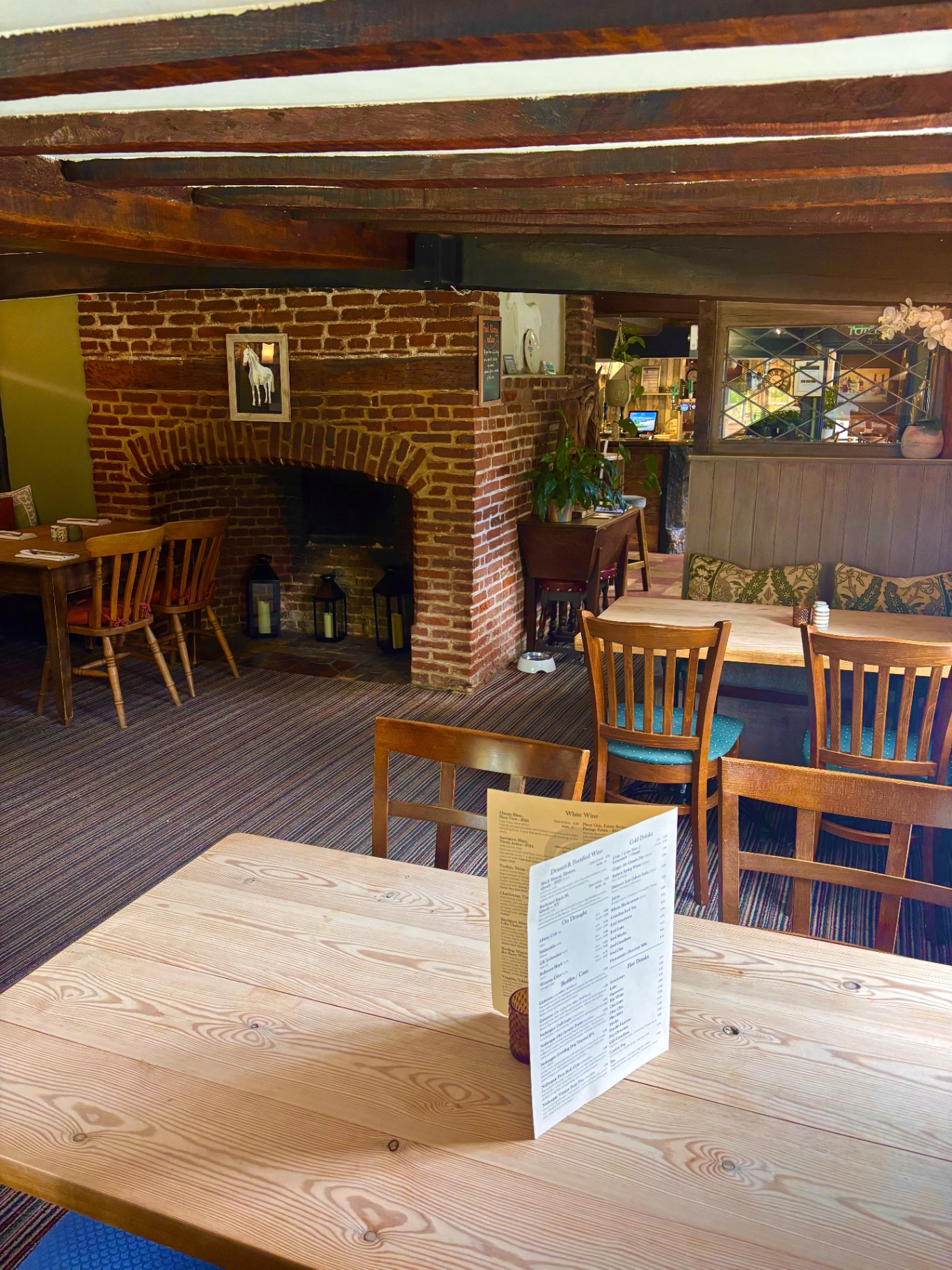
Original timber beams and interior of The White Horse

Four centuries of stories

A house built in the 1600s.

History

From farmhouse to country pub.

The White Horse Inn began life in the 17th century as a high-status farmhouse. The quality of the timber frame, the original oak boards underfoot and the carefully worked details throughout the building all point to a house of some standing — one that has been adapted and lived in for over 400 years.

Circa 1600

A 17th-century beginning

The architectural details of the frame suggest the farmhouse was built in the early 1600s, perhaps as early as circa 1600. It was laid out on the three-cell lobby entrance plan typical of the period: a front door opposite the chimney stack, a parlour to one side, and a hall to the other that served as kitchen, dining room, lounge and sometimes sleeping quarters for farm workers.

The craftsmanship

Details that survive

Look up in the bar and restaurant and you will see stop chamfer mouldings on the beams — a hallmark of 17th-century carpentry. Upstairs, an original door with fielded panels and HL hinges is a textbook example of the period, while wide oak floorboards on the first floor and in the attic may well be the very boards laid down four centuries ago.

The service end

A lost third bay

Beyond the hall once stood a third bay — the service end — used for storing foodstuffs and ale. Evidence of its studwork can still be seen in the mortises and peg holes in the beam above the bar. This bay was probably demolished in the 19th century to make way for a new parlour and master bedroom.

19th century

Adapting the house

The 19th-century extension replaced the old service end, and the roof over the 17th-century range was rebuilt at the same time. Yet the attic, reached by a winding stair beside the stack, still wears its wide oak boards — a quiet reminder that this space was used long before the Victorians altered the roofline.

“The quality of the timber frame indicates a high status house.”

Today, The White Horse is still a place to gather, eat and drink — much as the hall would have been when the house was young. We have simply swapped the farm labourers' bench for a few more tables.